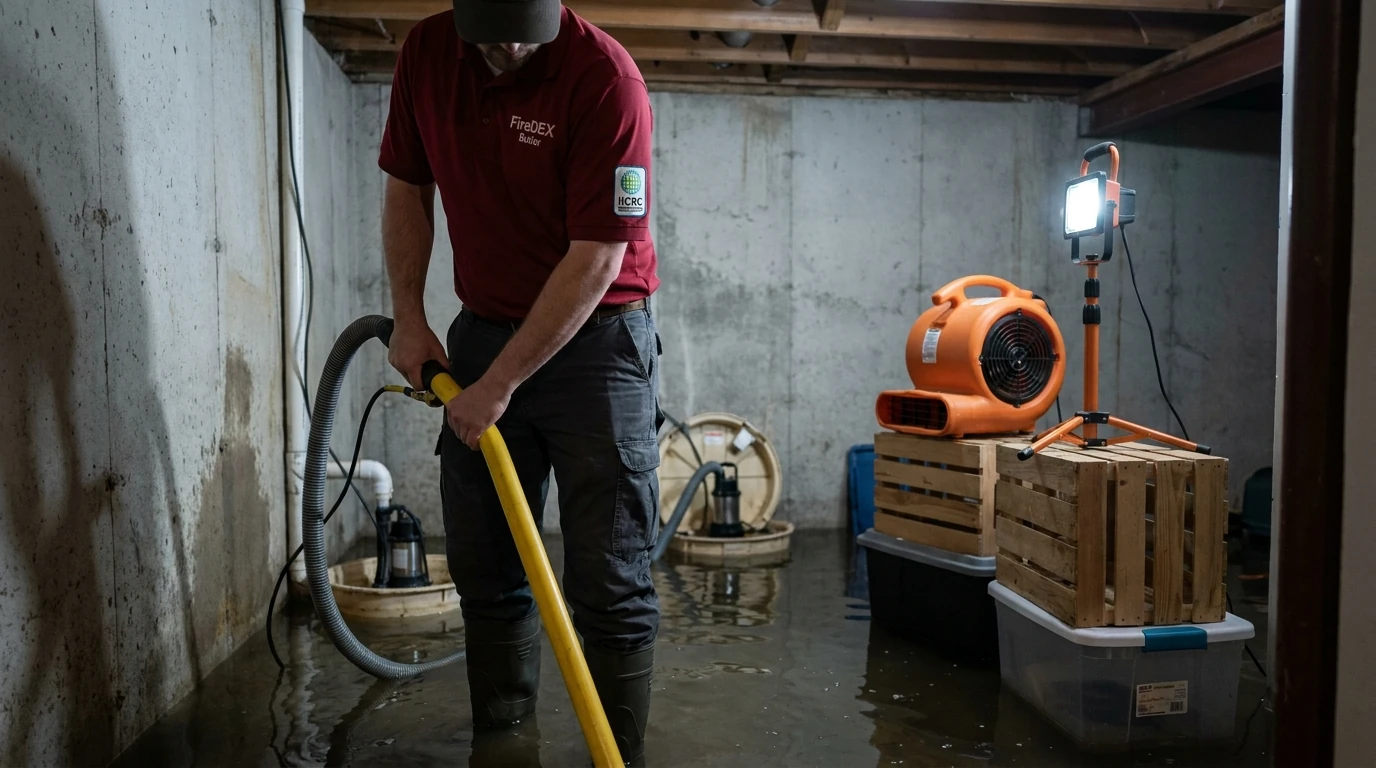
TL;DR: Water in the basement after heavy rain comes from three distinct sources: surface water driven in by poor grading or clogged downspouts, hydrostatic pressure pushing groundwater through foundation walls or floor cracks, or a failed sump pump or drain that could not keep up. The fix and the insurance coverage differ for each. Surface intrusion is often a grading correction. Seepage through block walls usually needs a waterproofing contractor. Sump failure cleanup is a restoration job. Mold can begin growing within 24 to 48 hours of any of these events, so drying time matters as much as finding the source.
You came home to standing water in the basement after last night’s storm. Before you start pulling up carpet or running a shop vac, it helps to know exactly where the water came from. The source determines what you can fix yourself, what needs a specialist, and what your homeowners policy will actually pay for. Those three answers are rarely the same.
Why Does My Basement Flood When It Rains?
Basements flood during heavy rain for three distinct reasons, and they often look identical once the water is on the floor. The first is surface water intrusion: rain falls faster than the ground can absorb it, pools against the foundation, and finds its way in through window wells, gaps at the sill plate, or a door threshold. The second is hydrostatic seepage: saturated soil builds pressure against the exterior of the foundation wall, and that pressure pushes water through porous block or poured concrete. The third is a sump pump or floor drain failure: the system designed to remove groundwater could not keep up with the volume, or the pump lost power during the storm.
In western Pennsylvania, all three happen regularly. Homes near Connoquenessing Creek in Zelienople and Butler, and those in the Breakneck Creek valley around Mars and Evans City, face genuine surface flooding risk during cloudburst summers. Newer sump-dependent builds in Cranberry Township and Seven Fields are more likely to see pump failure when a thunderstorm knocks out power for two hours. Pre-war stone and block foundations in older boroughs seep hydrostatically in any wet spring or summer.
Identifying the source before calling anyone saves you time and money.
How Do I Know Which Type of Water Entry I Have?
You can usually identify the source by where the water appears and what the walls look like. Surface intrusion tends to show water running in at a high point, like a window well or the base of an exterior door, and the floor near that entry point is wettest. Hydrostatic seepage shows as moisture weeping through the wall face itself, often with white mineral deposits called efflorescence left behind from previous events. The floor may be wet in the middle of the room, away from any obvious opening, because water is coming up through floor cracks or the cove joint where the wall meets the floor.
Sump pump failure is the easiest to confirm: the pit is full or overflowing, and the pump is either dead, running but overwhelmed, or tripped on a GFCI outlet. Check the outlet first before assuming the pump is burned out.
A few diagnostic steps:
- Look at the water entry point. High on the wall near a window or door suggests surface intrusion. Low on the wall or at the floor joint suggests hydrostatic pressure.
- Check for efflorescence (chalky white staining) on the wall face. This is a sign of repeated seepage, not a one-time event.
- Open the sump pit. Is it full? Is the pump running? Is the discharge line frozen or blocked?
- Walk the perimeter outside. Are downspouts discharging within four feet of the foundation? Is the grade sloping toward the house?
For a broader look at how water damage categories affect cleanup decisions, see Does Homeowners Insurance Cover Water Damage? A Plain-English Guide.
Will Homeowners Insurance Cover a Flooded Basement?
The insurance answer depends entirely on the source, and this is where most homeowners get an unpleasant surprise. Standard homeowners policies treat these three causes very differently.
Surface water from a storm (overland flooding): A standard homeowners policy almost never covers this. Flood damage from rising water, storm surge, or overland flow requires a separate National Flood Insurance Program (NFIP) policy or a private flood endorsement. If Connoquenessing Creek backs up into your basement, your standard policy will not pay.
Hydrostatic seepage through foundation walls: Also typically excluded. Insurers classify chronic groundwater seepage as a maintenance issue, not a sudden and accidental loss. If your block wall has been weeping for three seasons and finally soaked the carpet, that is generally not a covered claim.
Sump pump failure: This is the one that can be covered, but only if you purchased a sump pump failure rider (sometimes called a water backup endorsement). Without that rider, a failed sump pump is excluded the same way seepage is. The rider is usually inexpensive, often $50 to $150 per year, and it covers the cleanup and drying costs when the pump fails. If you are in Cranberry Township, Seven Fields, or any newer development built on a sump-dependent drainage system, this endorsement is worth adding before the next storm season.
For a full walkthrough of what to document before calling your insurer, the Storm Damage Insurance Claim Checklist covers what adjusters look for.
What Are the Immediate Steps After a Basement Flood?
The first priority is safety. Do not enter a flooded basement if you are not certain the electrical panel is dry and the circuit breakers serving that space are off. Water and energized outlets are a lethal combination.
Once it is safe to enter:
- Stop the source if possible. If a sump pump failed and you have a backup pump or a submersible rental pump, get it running. If downspouts are clogged, clear them. You cannot dry a space that is still taking on water.
- Document everything before moving anything. Photograph the water level on the walls, the contents, the sump pit, the entry points. This documentation protects your insurance claim.
- Remove standing water. A wet vac handles small amounts. For more than an inch of standing water across a significant area, extraction equipment moves water far faster.
- Pull up wet carpet and padding immediately. Carpet padding holds water like a sponge and is almost never salvageable. The longer it stays, the more moisture transfers into the subfloor.
- Get air moving. Open windows if outdoor humidity is lower than indoor humidity. Position fans to exhaust toward the outside, not just circulate the wet air.
The Flooded Basement: What To Do in the First 24 Hours post has a full step-by-step sequence if you want more detail on the immediate response.
Mold becomes a real concern starting at 24 to 48 hours after saturation, particularly in finished basements with drywall and insulation that hold moisture invisibly. The EPA’s mold cleanup guidance recommends that any porous material that has been wet for more than 48 hours and cannot be fully dried should be removed.
When Is This a Restoration Job Instead of a DIY Fix?
Some basement water events are genuinely manageable with a shop vac and fans. A small amount of surface intrusion on a concrete floor with no finished materials is one of them. Most are not.
Call a restoration company when:
- There is more than an inch of standing water across a meaningful area. Consumer equipment cannot extract fast enough to prevent secondary damage.
- The basement is finished. Drywall, insulation, and wood framing trap moisture that fans cannot reach. Drying a finished basement correctly requires calibrated LGR (low-grain refrigerant) dehumidifiers and air movers placed to move air through cavities, not just across surfaces. Moisture meters track the drying progress to the IICRC S500 standard’s target levels.
- The water sat for more than a few hours before you found it. The longer the saturation time, the deeper the moisture has migrated into structural materials.
- You are filing an insurance claim. Adjusters expect to see a documented drying log, moisture readings at baseline and throughout the drying period, and a written scope of work. A restoration company produces that documentation as part of the job.
- There is any gray or black water involved. If the backup includes sewage or the water came from a source you cannot confirm is clean, the cleanup requires disinfection, not just drying. This is a sewage cleanup situation, not a DIY one.
FireDEX Butler handles the water extraction, structural drying, and documentation side of basement flooding. Foundation waterproofing, which addresses the underlying seepage path through the wall, is a separate trade handled by a waterproofing contractor. The two jobs are sequential: restoration first to dry the structure, waterproofing after to prevent recurrence.
If you are dealing with water in the basement right now, FireDEX Butler is available 24/7 at (724) 452-7400. The crew can assess the water source, begin extraction, and set up a drying system the same day.
About FireDEX Butler
FireDEX Butler has served Cranberry Township, Butler County, and the Pittsburgh North suburbs since 1981, operating 24/7 for water, flood, storm, fire, and mold losses. The team handles basement flooding cleanup, water damage restoration, storm damage restoration, flood damage restoration, and the full range of residential and commercial restoration services across Butler and Allegheny counties. Pennsylvania Home Improvement Contractor Registration PA001913. Reach the crew any time at (724) 452-7400.