TL;DR: Water damage restoration in Western PA typically costs $1,500 to $12,000 for mitigation alone, with most losses falling in the $3,000 to $7,000 range. The biggest cost drivers are the category of water involved (clean, gray, or sewage), how many square feet are affected, how many days of drying equipment run, and whether structural reconstruction follows mitigation. Most residential claims are covered by homeowners insurance, so the out-of-pocket number is often just your deductible.
If you’re staring at a wet basement, a soaked ceiling from a burst pipe upstairs, or a finished lower level that took on water during last night’s storm, the first question is always the same: what is this going to cost me? The honest answer is that it depends on four things that a technician has to actually measure. This guide walks through each one so you know what the estimate should include and what your insurer is likely to pay.
What does water damage restoration actually cost?
In Western Pennsylvania, water damage restoration mitigation (extraction, drying, and antimicrobial treatment) typically runs $1,500 to $12,000. Most single-room losses land in the $1,500 to $4,000 range. Multi-room or finished-basement losses with structural drying run $4,000 to $9,000. Large-scale losses involving multiple floors, Category 3 water, or extended drying periods can reach $12,000 to $20,000 before reconstruction begins.
These are mitigation-only figures. If damaged drywall, flooring, cabinetry, or framing has to be rebuilt after drying, reconstruction is a separate line item. A finished basement rebuild in the Pittsburgh North suburbs can add $8,000 to $25,000 on top of mitigation, depending on finishes.
The ranges are wide because four variables move the number significantly. The sections below cover each one.
How does water category affect the cost?
The IICRC S500 standard classifies water losses into three categories, and the category is the single biggest cost driver after square footage.
Category 1 (clean water) comes from a supply line, a water heater, or a washing machine hose. It’s the least expensive to remediate because the water itself isn’t a contamination hazard. A Category 1 loss in a single finished room typically runs $1,500 to $4,000 for extraction and structural drying.
Category 2 (gray water) contains contaminants that can cause illness. Dishwasher overflows, sump pump failures, and washing machine drain backups are common sources. Category 2 requires more aggressive antimicrobial treatment and often means removing porous materials (carpet, pad, lower drywall) that can’t be adequately dried and sanitized. Expect $3,000 to $8,000 for a typical room or partial basement.
Category 3 (black water) is grossly contaminated: sewage backups, floodwater from outside, or any water that has sat long enough to become biologically hazardous. Category 3 requires full containment, PPE, disposal of all porous materials in the affected area, and heavy antimicrobial treatment. A Category 3 basement loss in a Western PA home routinely runs $6,000 to $15,000 for mitigation alone. If you had a sewage backup, see our sewage cleanup service page for what the remediation process involves.
Water can degrade categories quickly. Clean water from a burst pipe that sat undetected for 48 hours may be reclassified as Category 2 or 3 by the time a technician arrives. Speed of response matters for cost, not just damage.
How does square footage and drying class change the price?
Square footage is the multiplier on top of category. Restoration companies price by the affected area, not the whole house, but “affected area” includes wall cavities, subfloor, and structural framing, not just the visible wet floor.
The IICRC S500 also defines four classes of water damage based on how much moisture has been absorbed by structural materials:
- Class 1: Minimal absorption, small area. Fastest and cheapest to dry.
- Class 2: Significant absorption, water has wicked into walls and subfloor. Requires more equipment days.
- Class 3: Water saturated walls, ceilings, and insulation. High equipment count, longer drying time.
- Class 4: Specialty drying required for dense materials like hardwood, concrete, or plaster. Longest drying cycles, highest equipment cost.
A typical Western PA finished basement (600 to 900 sq ft) with a Class 2 loss runs $4,000 to $8,000 for mitigation. The same space with a Class 3 or 4 loss can run $8,000 to $14,000 because the drying equipment runs longer and more material has to be removed.
For a step-by-step look at what happens during the drying phase, see how long water damage restoration actually takes.
How much do equipment and labor add to the bill?
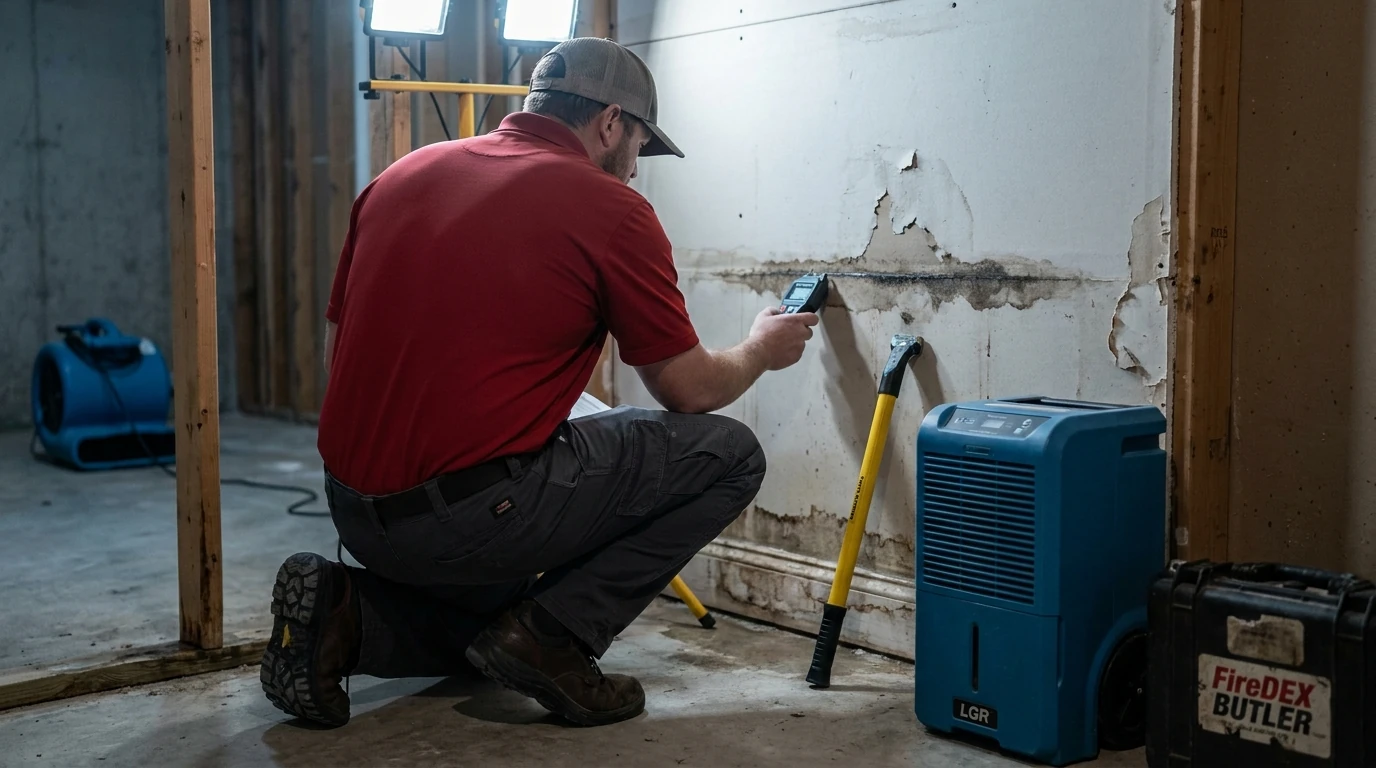
Equipment is rented by the day on your job, and the number of days is determined by moisture readings, not a calendar. Technicians use calibrated moisture meters and thermal imaging to set drying targets based on the IICRC S500 standard, then pull equipment when the structure hits those targets. Typical residential drying takes 3 to 5 days for Class 1 and 2 losses, 5 to 10 days for Class 3 and 4.
Here is a rough daily equipment cost breakdown for a typical basement loss:
| Equipment | Typical daily rate |
|---|---|
| LGR dehumidifier (large) | $75 to $150 per unit |
| Air mover / axial fan | $25 to $45 per unit |
| Truck-mounted extractor (first day) | $200 to $400 |
| HEPA air scrubber | $75 to $125 per unit |
| Thermal imaging inspection | $150 to $300 (one-time) |
A mid-size basement loss might run 2 dehumidifiers and 6 to 8 air movers for 5 days, which puts equipment alone at $1,500 to $3,000 before labor. Labor for extraction, demolition of unsalvageable material, antimicrobial application, and daily monitoring adds $800 to $2,500 depending on scope.
Does homeowners insurance cover water damage restoration?
Most standard homeowners policies cover sudden, accidental water damage, which means the majority of mitigation costs are an insurance claim, not an out-of-pocket expense. Your deductible (commonly $1,000 to $2,500) is usually the only amount you pay directly. The Insurance Information Institute has a plain-English breakdown of what standard policies include.
What is typically covered:
- Burst pipes and supply-line failures
- Appliance overflows (washing machine, dishwasher, water heater)
- Sudden roof leaks that let water in
- Ice dam damage
What is typically NOT covered:
- Gradual leaks or seepage that built up over time
- Flooding from outside (requires separate NFIP or private flood policy)
- Sump pump failure (requires a separate sump pump rider, common in Western PA)
- Backup of sewers or drains (requires a separate endorsement)
Sump pump riders and water backup endorsements are inexpensive add-ons worth checking on your policy before the next storm. Butler County’s clay soil and Cranberry Township’s spring thaw season make sump failures a recurring event, not a rare one.
Documentation is what protects your claim. A restoration company should provide a written scope of work, daily moisture logs, and photo documentation before and after drying. That paper trail is what the adjuster needs to approve the full mitigation cost. For more on the insurance side of a water claim, see does homeowners insurance cover water damage.
What happens if you wait to call?
Delaying restoration increases cost in two ways. First, water migrates. What starts as a wet carpet becomes saturated subfloor, then wet framing, then wet insulation, then a Class 3 or 4 loss that takes twice as long to dry. Second, mold can begin colonizing porous materials within 24 to 48 hours of a water event, according to EPA guidance. Mold remediation is a separate scope of work with separate costs, typically $1,500 to $6,000 for a contained area.
If you had a loss more than 24 hours ago and haven’t had a moisture assessment, the scope may already be larger than it looks. See how quickly mold grows after water damage for what to watch for.
What should you do right now?
If the source of water is still active, stop it first: shut the main water supply valve or call a plumber. If a pipe is the cause, the burst pipe emergency checklist walks through the first steps. Then call a restoration company for an assessment.
A written scope of work should be in your hands before any work begins. The scope should itemize affected square footage, water category and class, equipment plan, estimated drying days, and any demolition required. Never authorize work based on a verbal estimate alone.
For Western PA homeowners who need an assessment, FireDEX Butler is available 24/7 at (724) 452-7400 and handles the full scope from extraction through reconstruction so you work with one company through the whole claim.
About FireDEX Butler
FireDEX Butler has served Cranberry Township, Butler County, and the Pittsburgh North suburbs since 1981 (PA Home Improvement Contractor Registration PA001913). Their crews handle water damage restoration, basement flooding cleanup, burst pipe repair, flood damage, storm damage, fire and smoke restoration, mold remediation, biohazard cleanup, and reconstruction across the region. Available 24/7 at (724) 452-7400.