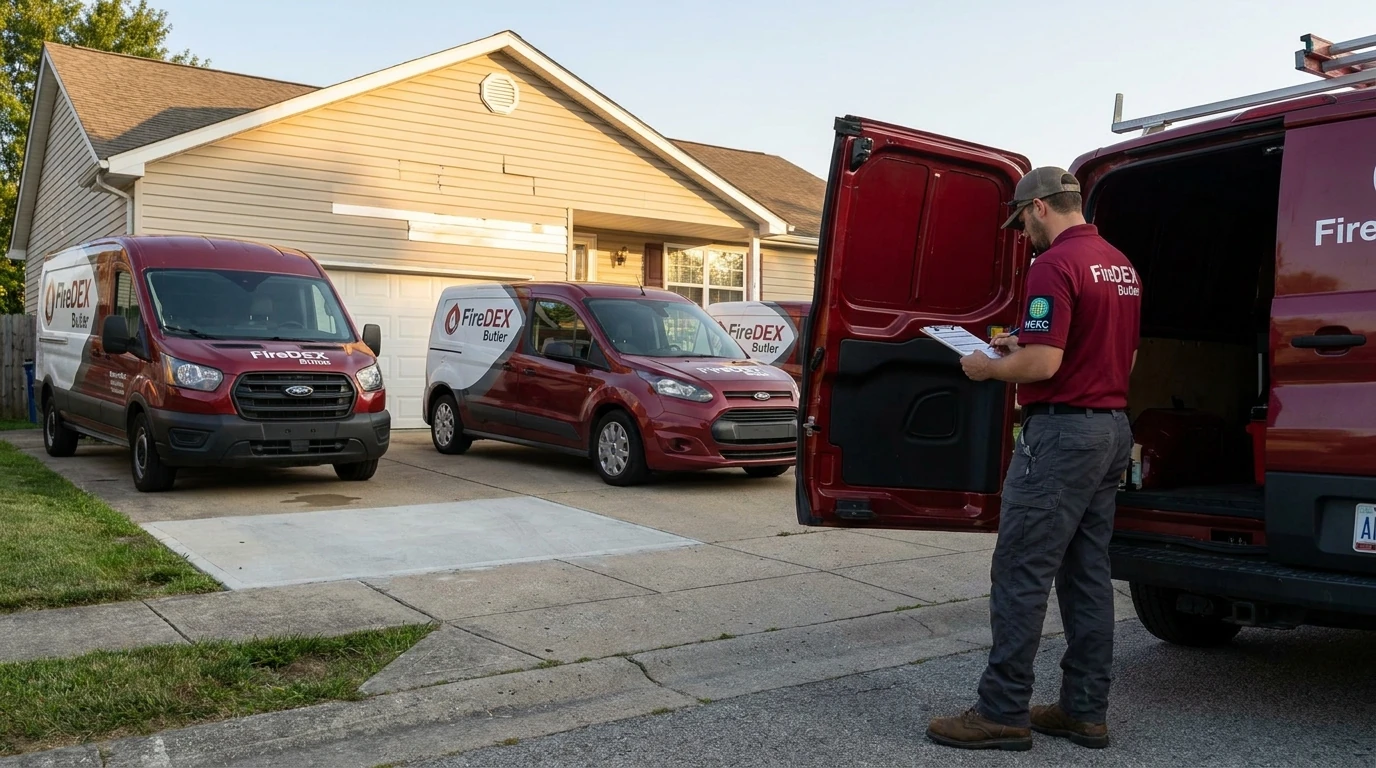
Some restoration calls start with a flooded basement at 2 a.m. This one starts quieter: a homeowner who needed repair work done right, on a schedule that actually held, from the first estimate to the final walkthrough. That’s the kind of call Sue made to FireDEX Butler, and her review is short enough to read in full.
“I had a great experience with FireDEX. They were great to work with. Quick to get me a quote and to schedule the repairs. The job they did turned out fantastic and I would call them again if the need arises. Hands Down Solid 5 Star!!” , Sue, verified Google review
That’s the whole review, five stars and four sentences. It doesn’t name a project address, a damage type, or a dollar figure, so this case study won’t invent any of those either. What it does give is four specific claims about how a repair job ran, and each one points to a real part of the process worth breaking down.
”Quick to get me a quote”
A fast estimate usually means a crew has its process dialed in, not that they’re guessing at scope on the fly. That speed only matters if the estimate is also accurate, which is the harder part.
A solid repair estimate itemizes the work: what’s being replaced versus repaired, the materials involved, labor, and a realistic start date. It should read like a scope of work, not a ballpark number scrawled on a business card. For anything tied to an insurance claim, a written, itemized scope is also what an adjuster expects to see before authorizing payment, which is part of why getting the estimate right the first time saves weeks later.
If you’re comparing multiple estimates for repair or restoration work, our guide on choosing a restoration company covers the questions worth asking before you sign anything.
”Quick to schedule the repairs”
Scheduling speed depends on crew capacity and material lead times, two things a homeowner can’t see but definitely feels. A crew that quotes a date and holds it is doing real coordination behind the scenes.
That coordination usually means confirming material availability before committing to a start date, sequencing any trade work (drywall before paint, framing before flooring), and building in a buffer for anything hidden that turns up once walls or flooring come out. Repair projects that slip are almost always ones where scheduling happened before the scope was actually locked down.
”The job turned out fantastic”
A repair that “turns out fantastic” almost always comes down to two unglamorous things: matching finishes and a final walkthrough. Skip either one and the work can be structurally fine and still look wrong.
Matching existing trim, paint sheen, flooring, or siding takes more attention than installing new material from scratch, since the goal is for the repair to disappear into the rest of the house. A final walkthrough, ideally with a punch list the homeowner signs off on, is what catches the small stuff (a scuffed baseboard, a paint touch-up) before the crew packs up rather than after.
”I would call them again”
A repeat-customer comment like this is really a statement about trust built over the life of the project, not just the finished result. It suggests the communication held up too: clear updates, no surprise change orders sprung at the last minute, and a company that answers the phone the same way after the invoice is paid as before it.
That’s worth paying attention to when you’re evaluating who handles a repair or restoration job on your own property. A single good outcome is nice. A homeowner who says they’d call again is a stronger signal.
If your own project involves storm damage, water damage, or reconstruction work in the Cranberry Township, Butler County, or Pittsburgh North suburbs, request a written estimate and expect the same kind of process Sue describes: a clear scope, a scheduling commitment, and a walkthrough before the job is called done.
About FireDEX Butler
Founded in 1981, the company is a registered Pennsylvania Home Improvement Contractor (registration PA001913) serving Cranberry Township, Butler County, and the Pittsburgh North suburbs. FireDEX operates a 24/7 emergency line and handles restoration and repair work across water, fire, storm, mold, and reconstruction, along with general contracting for homes and businesses throughout the region.