TL;DR: Mold remediation in Cranberry Township typically costs $500 to $1,500 for a small, contained spot, $1,500 to $6,000 for a basement wall section or attic area, and $6,000 to $30,000+ for a whole finished lower level or multi-room job. The biggest cost drivers are square footage, how much material has to be cut out, and whether the moisture source (often clay-soil seepage in this area) gets fixed as part of the job, not just the visible mold.
If you pulled up a section of drywall near a basement window well and found dark staining, or your home inspector flagged musty sheathing in the attic, you are probably trying to figure out whether this is a $600 fix or a $15,000 one before you call anyone. The honest answer: it depends almost entirely on how much area is affected and what is behind the surface you can see. Cranberry Township’s heavy clay soil and the sheer number of finished basements in neighborhoods like Fernway, Fox Run and Ehrman Farms make basement mold from hydrostatic seepage one of the more common calls in this township, so that scenario gets its own section below.
How much does mold remediation cost per square foot?
Mold remediation is usually priced by scope and labor hours rather than a flat per-square-foot rate, but most jobs land somewhere between $10 and $25 per square foot of affected material once containment, air scrubbing and disposal are included. A 10-square-foot patch behind a leaking window costs far less in total than 200 square feet of water-stained basement drywall, even at a similar per-square-foot rate, because larger jobs need more containment plastic, more HEPA air scrubber run-time, and more disposal trips.
Square footage alone does not tell the whole story. A small area with extensive hidden growth behind a vapor barrier can cost more to remediate than a larger area of light surface mold on a single drywall sheet, because the labor is in removing and containing material, not just the square count.
What does mold remediation cost by project scope?
The table below reflects typical ranges reported across the restoration industry for jobs of this type and size; your actual quote depends on the inspection findings, not a flat rate.
| Scope of the job | Typical cost range |
|---|---|
| Small contained area (under 10 sq ft, e.g. a bathroom ceiling patch) | $500 - $1,500 |
| Basement wall section (clay-soil seepage line, one to two walls) | $1,500 - $3,500 |
| Attic sheathing and insulation (poor ventilation driven) | $2,000 - $6,000 |
| Whole finished lower level (containment plus rebuild) | $6,000 - $15,000+ |
| Whole-house remediation (multiple rooms, HVAC involvement) | $10,000 - $30,000+ |
These ranges assume the mold is Cladosporium, Penicillium or similar common household growth. Extensive hidden mold discovered only after demolition begins, or mold that has reached ductwork, will push a job toward the higher end of its bracket.
What actually drives the price up or down?
Five factors move the number more than anything else: how much material has to be physically removed, how the space is contained, how long air scrubbing runs, whether rebuild is needed, and whether the moisture source gets addressed in the same scope.
Material removal. Mold growing on a hard, non-porous surface like tile or metal can often be cleaned in place. Mold on drywall, carpet, insulation or wood framing usually has to be cut out and disposed of, because porous materials hold spores in ways surface cleaning cannot fully reach. That removal, not the cleaning itself, is usually the biggest line item.
Containment. Any job beyond a very small spot needs the work area sealed off with poly sheeting and run under negative air pressure, so spores do not spread to the rest of the house during removal. Containment setup and teardown adds labor hours regardless of square footage.
HEPA air scrubbing. The EPA’s guidance on mold and moisture notes that removing the mold source and controlling moisture are the keys to long-term control; HEPA air scrubbers run for the duration of the containment period to capture airborne spores disturbed during removal, which adds equipment rental time to the invoice.
Rebuild. Cutting out moldy drywall, subfloor or insulation is only half the job. Putting the space back together, often with mold-resistant board in basements, is a second cost that gets bundled into whole-level jobs.
The moisture source. This is the one homeowners most often leave out of their mental budget, and it is covered on its own below.
Why does basement mold cost more in Cranberry Township specifically?
Basement mold remediation in this township tends to cost more than the national average for comparable square footage because the moisture problem is usually structural, not incidental. Cranberry sits on heavy clay soil that does not drain quickly, so after a wet spring or a hard thunderstorm, hydrostatic pressure pushes water through foundation walls even in homes with no visible crack. Combine that with how many Cranberry basements are finished living space, with carpet, drywall and framed walls over the foundation, and a seepage line that would be a minor nuisance in an unfinished basement becomes a multi-wall tear-out in a finished one.
Homes in the 1960s-era Fernway section also carry original foundation drainage that was never built for today’s grading and gutter loads, which is part of why repeat basement mold calls cluster there. If your basement mold keeps coming back after cleaning, the growth usually is not the real problem: the seepage path feeding it is, and that is a foundation or drainage question, not just a remediation one.
Who pays for mold remediation, insurance or the homeowner?
Homeowners insurance typically only pays for mold remediation when the mold resulted from a sudden, covered water event, like a burst pipe, not from long-term seepage, humidity or a maintenance issue. A slow basement leak that has been seeping for months is the kind of claim insurers are most likely to deny, because most policies exclude damage from gradual or preventable moisture.
If the mold followed a recent covered loss (a water heater failure, a burst supply line, a sump pump that failed during a storm), document it immediately: photos of the original water event, a written moisture-mapping report, and lab-confirmed species if the adjuster requests it. If the mold is tied to ongoing clay-soil seepage, budget for it as an out-of-pocket home maintenance cost paired with a drainage fix, since that is how most PA homeowner policies will treat it.
What does the remediation process actually involve?
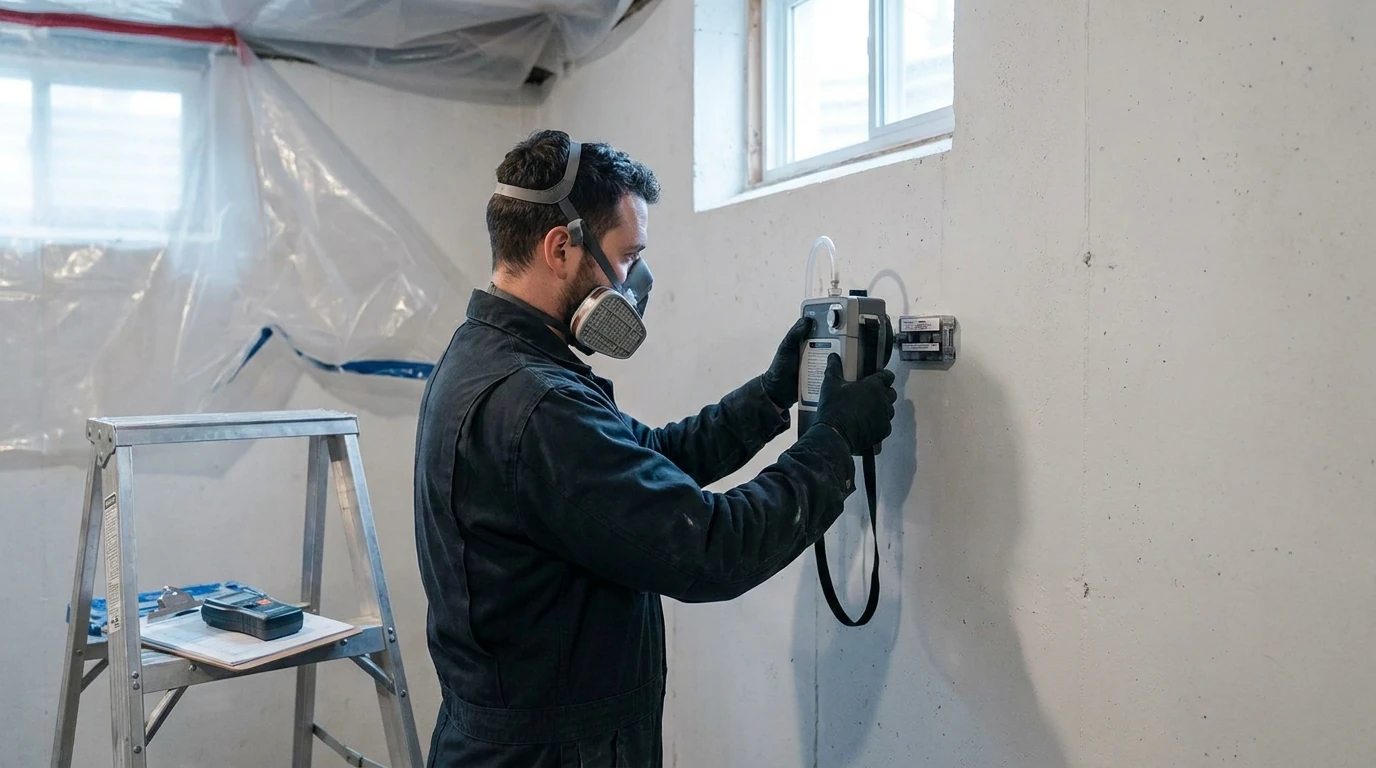
A professional mold remediation job generally follows the same sequence regardless of scope, and understanding it explains where the cost goes. First, an inspection identifies the extent of growth and the moisture source, sometimes with a moisture meter and testing, covered in more detail here. Second, the work area is contained with poly sheeting and negative air pressure to keep spores from migrating. Third, HEPA air scrubbers run throughout removal. Fourth, affected porous materials are cut out and bagged for disposal, while hard surfaces are HEPA-vacuumed and treated with an antimicrobial. Fifth, the space is dried to confirm no residual moisture remains. Sixth, a post-remediation verification (visual or lab-based) confirms the work is complete before rebuild starts.
Who should you call for a mold estimate in Cranberry Township?
Call a local restoration company for an in-person inspection before you budget off any online range, since the only way to price your specific job accurately is to see what is behind the wall. FireDEX Butler, based on Marshall Rd in Cranberry Township and operating 24/7, provides mold inspections and written remediation scopes for homes across Butler County, including the Fernway, Fox Run and Ehrman Farms areas where basement seepage is common.
A written scope before any work begins should spell out the square footage involved, what gets removed versus cleaned, how long containment runs, and whether the moisture source repair is included or is a separate referral. If a quote skips the moisture source entirely, ask why, because mold that returns in six months because the leak was never fixed is the most expensive outcome of all.
About FireDEX Butler
FireDEX Butler has served Cranberry Township and Butler County since 1981, holding Pennsylvania Home Improvement Contractor registration PA001913 with the PA Attorney General’s office. This article was prepared with input from the FireDEX Butler team, who handle mold inspection, testing and remediation scopes across the Pittsburgh North suburbs.
Need help now? Call FireDEX Butler at (724) 452-7400.